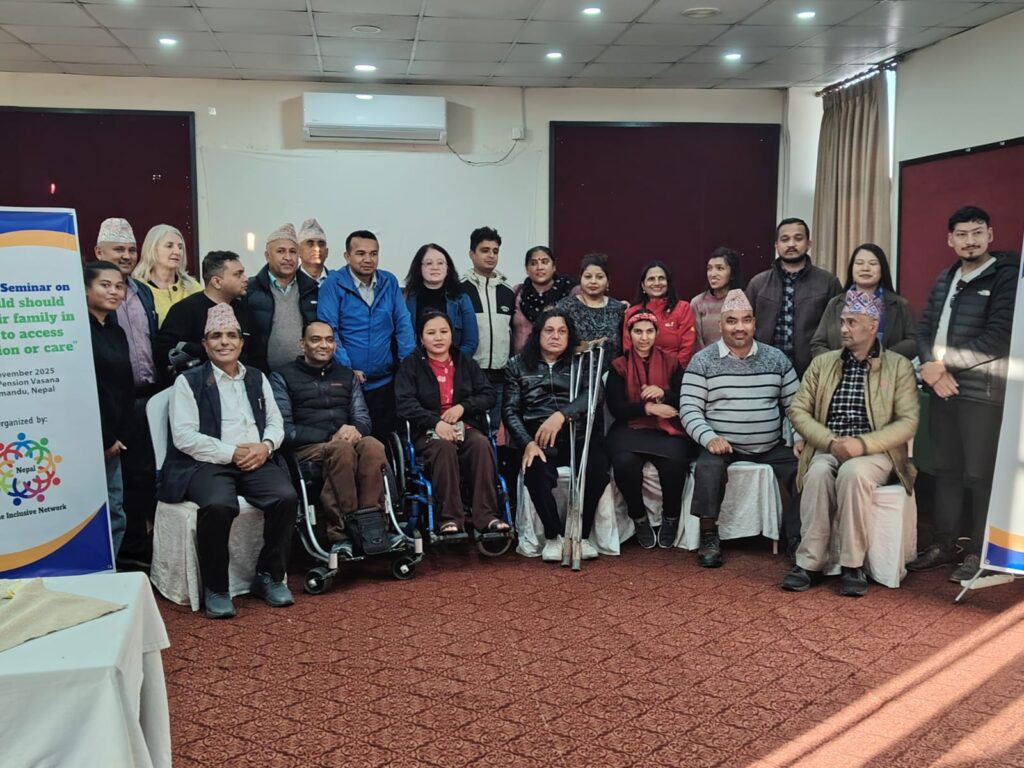
On 14 November 2025, the Inclusive Network, Nepal organized a One-Day National Seminar titled “No Child Should Lose Their Family to Access Education or Care” in Kathmandu. The seminar brought together government officials, civil society organisations, organisations of persons with disabilities (OPDs), researchers, child rights advocates, service providers, and parents to examine the growing institutionalization of children in Nepal, particularly children with disabilities.
The seminar highlighted that despite Nepal’s constitutional commitments, ratification of international conventions, and existing policy frameworks on child rights and disability inclusion, an estimated 12,000 children are currently living in residential care facilities, of whom approximately 8,000 are children with disabilities. Many of these children remain undocumented, unrepresented, and invisible within national systems. Participants emphasized that institutionalization in Nepal is not driven by children’s best interests but by systemic failures, weak governance, donor preferences, and entrenched institutional business models.
Discussions revealed that families are often forced into an impossible choice: sending their children away to access education or care, or keeping them at home without any support. Evidence presented during the seminar showed that most parents do not want institutional care for their children; rather, they want accessible services, guidance, and support within their communities. The seminar stressed that when families are pressured, misled, or denied alternatives, institutional placement can meet the international definition of child trafficking, particularly for children with disabilities.
The seminar reaffirmed Nepal’s obligations under the Convention on the Rights of the Child (CRC), the Convention on the Rights of Persons with Disabilities (CRPD), and the 2019 UN Resolution on the Rights of the Child, which emphasizes that children should never be separated from their families solely due to poverty or lack of access to education or services. Participants noted that Nepal welcomed this resolution and pledged to initiate deinstitutionalization, yet inconsistent government actions and lack of a comprehensive national strategy continue to undermine progress.
Presentations and reflections examined the national context, including the expansion of child care homes, resource classes, and special schools, particularly for children with disabilities. Research findings shared during the seminar showed that more than 90% of children in care homes have living parents, and that residential and resource class models deliver poor educational and developmental outcomes despite high costs. Studies also demonstrated that community-based and family-based services are more effective and cost-efficient when properly implemented.
Speakers emphasized that deinstitutionalization is not achieved through legislation alone but requires a comprehensive, disability-inclusive national care reform strategy, supported by strong coordination across government levels and meaningful participation of OPDs. Without disability inclusion, care reform remains incomplete and discriminatory, leaving children with disabilities behind.
Participants identified key factors driving separation in Nepal, including poverty, lack of local inclusive services, migration, donor-driven institutional models, volunteerism, religious recruitment, and deeply rooted beliefs that segregation is best for children with disabilities. It was stressed that children with disabilities are systematically institutionalized not because of necessity, but because community-based services are weak or absent and families are denied information and support.
Throughout the seminar, speakers and participants shared powerful messages, noting that children with disabilities are rights holders, not special cases, and that parents are not abandoning their children—the system is abandoning families. The seminar underscored that consent becomes coercion when no alternatives are provided and that institutionalization continues because families are made to feel powerless.
The seminar concluded with a strong call for coordinated action. Participants urged the government to develop a national disability-inclusive deinstitutionalization strategy, strengthen community-based services, halt the expansion of residential care, and ensure OPD participation in all care reform processes. Donors were encouraged to stop funding institutional models and invest in family- and community-based care, while CSOs and OPDs were called upon to build unified coalitions and advocate collectively.
The final message of the seminar was clear:
No child should lose their family to access education or care.
No child should be institutionalised.
No child should be left behind.