Nepal is home to more than 9.8 million children, yet over 355,000 children live apart from their biological parents, with a significant number placed in institutional care. According to the Status Report 2080, 398 registered children’s homes are operating across 45 districts, currently housing approximately 11,000 children, despite the fact that more than 80 percent of these children have living parents. This widespread reliance on institutional care continues even though both national and international frameworks clearly state that institutionalization should be used only as a last resort.
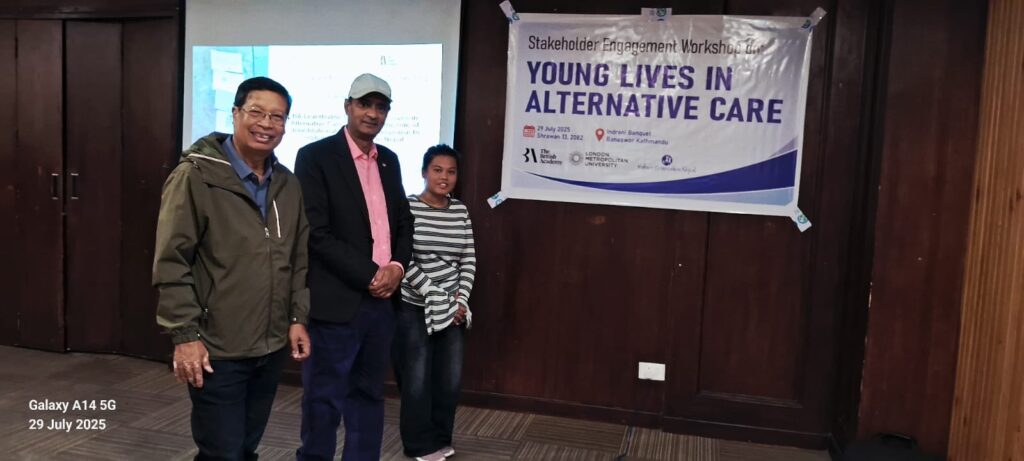
Against this backdrop, the Stakeholder Engagement Workshop on “Young Lives in Alternative Care”, held on 29 July 2025, brought together experts, policymakers, researchers, and care-experienced young people to reflect on these urgent concerns. The workshop was organized by London Metropolitan University and Future Generation Nepal under the BA/Leverhulme Grant. Discussions emphasized the need for stronger family reintegration mechanisms, expansion of family-based care alternatives, and decisive action to end orphanage trafficking in Nepal. Participants highlighted the importance of aligning care reforms with existing legal and policy frameworks, including the Child Rights Act, the Human Trafficking and Transportation (Control) Act (HTTCA), and local government standards, to ensure every child’s right to grow up in a safe, supportive, and family-oriented environment.
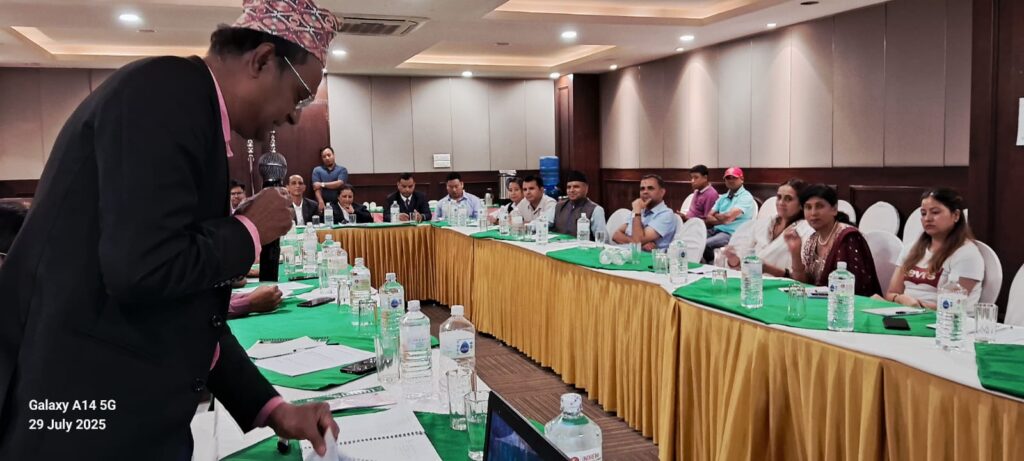
During the workshop, Disability Human Rights Promotion Society (DHRPS) strongly raised the concern that the disability perspective remains largely absent from alternative care discussions. Children with disabilities are among the most marginalized and invisible within institutional care systems, and their lived experiences are distinct and often overlooked. DHRPS advocated for disability to be meaningfully integrated into all research, policy reform, and care transition processes.
The discussion reaffirmed that true deinstitutionalization cannot be achieved without disability inclusion. Any effort to reform alternative care systems must ensure that children with disabilities are not only counted in data and policies but are actively included in shaping solutions. Without this, care reform risks leaving the most vulnerable children behind.