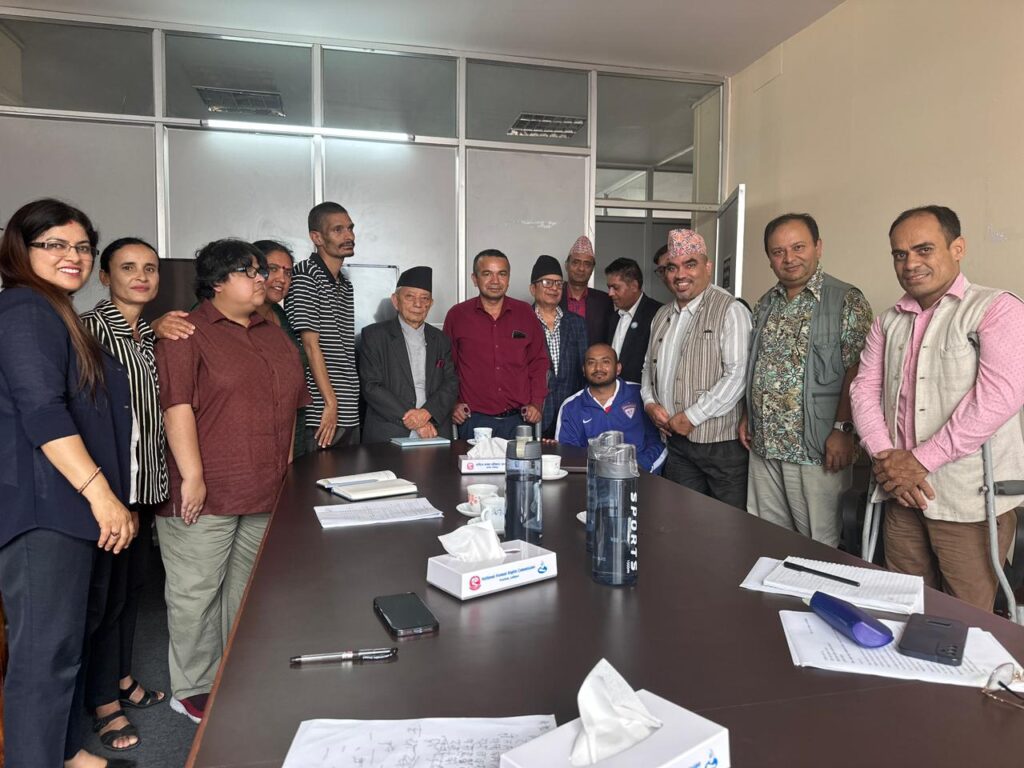
On 6 May 2025, allies of Organisations of Persons with Disabilities (OPDs), in collaboration with the Disability Human Rights Promotion Society (DHRPS) with the initiation of Inclusive Network held a lobby meeting at the National Human Rights Commission (NHRC) to demand urgent action against ongoing violations of disability rights caused by institutionalization practices in Nepal. During the meeting, the coalition jointly submitted a formal complaint and memorandum to the Commission.
Representatives from OPDs stood united at the NHRC to raise their collective voice against the continued separation of children with disabilities from their families in the name of education and care. The delegation emphasized that institutionalization, even when presented as a protective or welfare-oriented measure, isolates persons with disabilities from their families, cultures, and communities, undermining their dignity and fundamental rights.
Discussions highlighted that research and lived experiences consistently show that institutional care often results in emotional neglect, loss of language and identity, and increased exposure to abuse. Participants stressed that thousands of children in Nepal have already been separated from their families, despite the fact that the vast majority have living parents who want to care for them if adequate community-based support is available.
The delegation reaffirmed that every child has the right to live with their parents and grow up within their family and community. Deinstitutionalization was described not merely as a policy reform, but as a justice movement aimed at restoring dignity, respecting autonomy, and building inclusive support systems that enable persons with disabilities to thrive in their own homes.
During the meeting, the coalition demanded a rights-based, community-centered approach to care and support. They urged the NHRC to independently investigate institutionalization practices, initiate multi-stakeholder dialogue, and publicly articulate its position on the issue. The group also called for urgent policy reforms to prioritize inclusive education, develop community-based support systems, and expand personal assistance services, particularly for persons with intensive support needs.
Concerns were raised regarding recent government actions that contradict Nepal’s constitutional and international commitments. Despite Nepal being a democratic republic committed to human rights, federalism, and welfare-state principles under the Constitution of Nepal (2015) and the UN Convention on the Rights of Persons with Disabilities (CRPD)—which Nepal ratified in 2006—recent policy directions were described as regressive.
Participants highlighted that the Ministry of Women, Children, and Senior Citizens is currently revising the Disability Rights Act (2017). While some proposed provisions were welcomed, the delegation expressed serious concern over clauses that encourage the establishment of residential care centers at the local level. Such provisions directly contradict the CRPD and risk further separating children with disabilities from their families.
Evidence shared during the briefing indicated that nearly 8,000 children have already been separated from their families under the guise of education. Rather than promoting inclusion, the expansion of residential centers was described as deepening isolation, particularly for children and persons with significant support needs.
The delegation stressed that in an era of technological advancement and global progress—where international frameworks promote independent living and community inclusion—the expansion of residential institutions represents a step backward and a violation of human dignity, freedom, and rights.
All NHRC staff members, including the Honourable Chairperson of the National Human Rights Commission of Nepal, Mr. Top Bahadur Magar (Former Justice), were briefed during the visit. The coalition urged the Commission to act swiftly and publicly in defense of the rights and dignity of persons with disabilities.
The meeting concluded with a strong call to nurture a new generation of leaders who reject institutionalization and advocate for a Nepal where every person, regardless of ability, has the right to belong, participate, and lead within their community.